Smart Rural Living | Bank of China
Designing a FinTech-Driven Cross-Platform Service for Rural Governance
Introduction
Smart Rural Living is a project by Bank of China to digitize village governance through a points-based incentive system linked to villagers’ financial identities. I led end-to-end design of a multi-terminal platform—including the admin console, mobile inspection app, redemption station, and an in-app web module—to help local administrators streamline workflows, increase villagers’ participation, and expand access to digital financial services.
The team
2 PMs, 3 Designers, 6 developers
My Role
Lead Designer
TImeline
Dec 2021 - Nov 2022

To turn these goals into actionable design directions, we started by asking a few simple questions:
Who are the people behind rural governance?
What roles do they play, and how do they currently handle their daily work?
What challenges do they face?
Where do the processes slow down, break, or create extra effort for villagers and managers?
Where could financial touch points be built into these routines?
How might we find moments where Bank of China could support users by offering useful and timely financial access.
With these questions in mind, we went into the field—talking to local government staff and villagers—to understand their real tasks, frustrations, and expectations.
User research
Our research aimed to uncover routines, workflows, and key pain points in rural governance.
We conducted in-depth interviews, contextual inquiries, and field shadowing with local staff and villagers over three working days in Yucun Village, Huzhou, Zhejiang.
From these studies, we mapped out the main roles involved in rural governance—managers, inspectors, and villagers—each playing a distinct part in the governance loop.
Managers
Managers coordinate rural governance, assign tasks to inspectors, and guide villagers to follow community rules.
Pain points:
They work with documents and files where the information is scattered across different formats and locations, making management time-consuming and inefficient. They also lack structured information to support decision-making.
Behavioral Focus:
Decision & Coordination
Inspectors
Inspectors are responsible for on-site inspections of village environments and household conditions, collecting and reporting information.
Pain points:
They still use paper to record data and later re-enter it into computer files when they inspect on-site, which leads to inefficiencies. Their judgments can also be subjective, which affects data consistency.
Behavioral Focus:
Execution & Data Collection
Villagers
Villagers follow traditional lifestyles and they carry out community duties such as maintaining shared areas, sorting waste, and joining collective activities.
Pain points:
Their challenges include not receiving rule updates in time and feeling little motivation to engage the community duties and activities.
Behavioral Focus:
Daily Routines & Rule Following
User quotes
Selected quotes from interviews that reflect the main challenges of each group.
"We’ve already held a few incentive-based activities, but they were all one-time efforts with no lasting impact after that.”
— Mr. Wu, Manager
"Now we write things down with pen and paper on site, then go back to the office and enter everything into Excel."
— Mr. Liu, Inspector
“Every time I go on the inspect task, I have to walk through the entire village — it takes the whole day, and it's just exhausting."
— Ms. Wang, Inspector
"Following the village rules is tiring and troublesome. We just want an easier life. If the streets and environment are a bit messy, we can live with it."
— Mr. Ma, Villager
"I’m not really sure what the village rules are. I know there’s a board at the township center, but I haven’t really studied it. Even if I did, I probably can’t remember it well anyway."
— Ms. Yang, Villager
Insights
By spending time with managers, inspectors, and villagers, we were able to see how rural governance plays out in everyday practice. What stood out were not only the tasks they performed, but the tensions and gaps hidden within their routines.
These insights highlight the core frictions in the system and guided how we shaped the design direction that followed.
Updates reach villagers slowly, and feedback is rarely provided after tasks.
Without visible outcomes, participation feels like extra work rather than meaningful contribution.
Irregular engagement makes governance activities difficult to sustain.
Villagers are identified by names or phone numbers, creating duplicate and outdated records.
Actions and benefits cannot accumulate around a consistent identity.
Service history and incentives remain fragmented, preventing long-term trust and continuity.
“How might we build an integrated governance ecosystem where information, identity, and incentives circulate seamlessly across all stakeholders?”
Solutions & Strategies
Our insights showed that the core issues were not about people, but about how the system works. To move governance forward, we focused on three simple directions:
1. Build a digital management platform — Make information clear and shared
Governance breaks when each role works with different pieces of information. We needed a digital foundation that helps everyone see the same facts and stay aligned.
2. Create a “task–points–reward ” mechanism
Villagers participate more when their effort is seen. Turning daily tasks into points and rewards helps make participation clearer and more meaningful.
3. Anchor personal records with a stable financial identity
Village records work when they reliably connect to individuals. By using bank cards as the primary identity, the system ties every action—tasks, inspections, points, and redemption—to one reliable record. This connects rural governance with financial services in a seamless, scalable way.
Based on these strategies, we designed a connected system that brings together managers, inspectors, villagers, and the redemption process into one closed loop. The solution includes four core modules:





Information Architecture
We split the solution into four subsystems to match how work actually happens — where information is created, processed, redeemed, and reviewed.
These four subsystems work together as one ecosystem, allowing tasks, records, and rewards to move smoothly across roles while keeping information transparent and traceable.
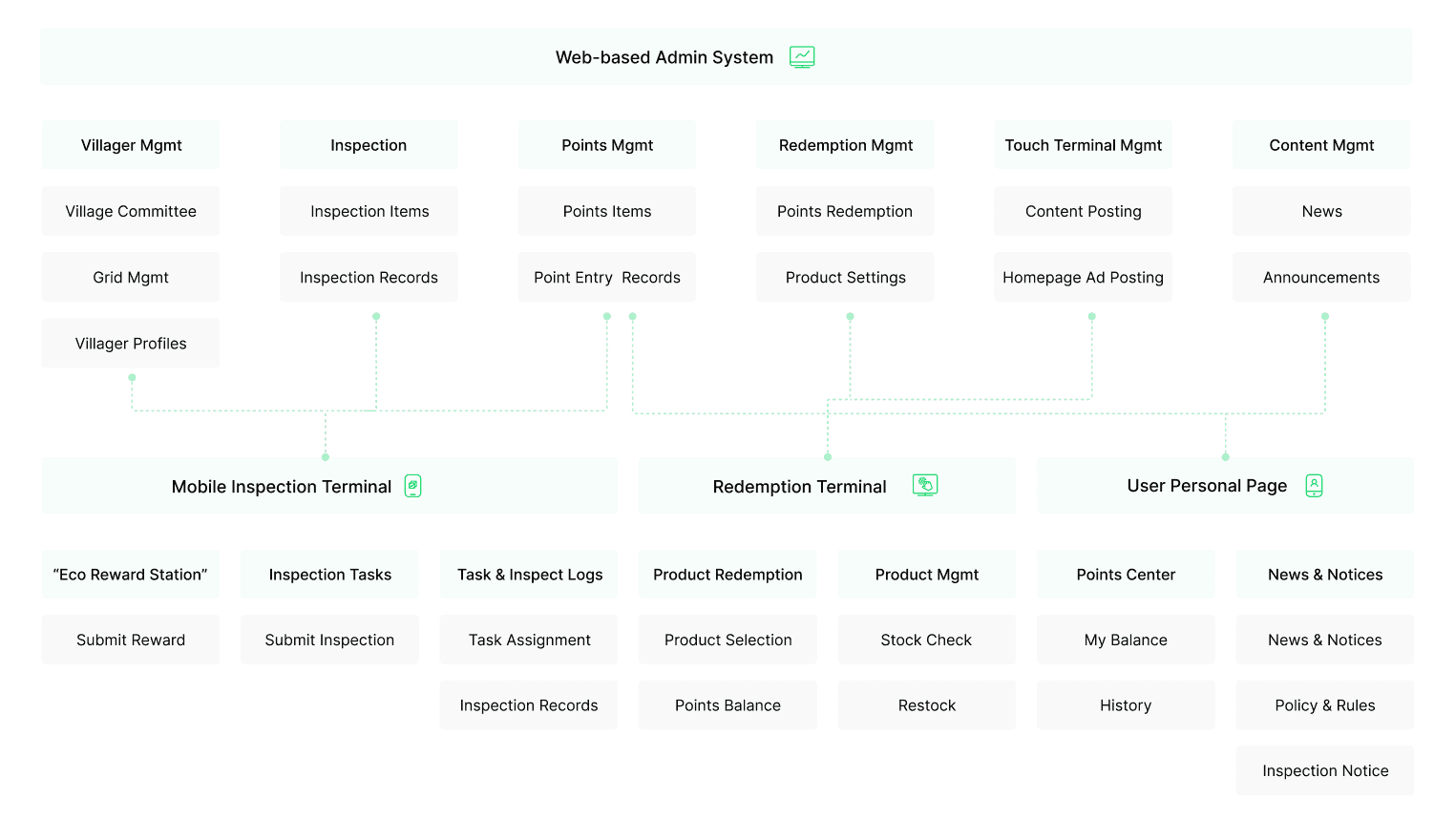
We focused on clarity, efficiency, and consistency as we designed the core flows and interfaces for four system.
01
Web-based Admin System
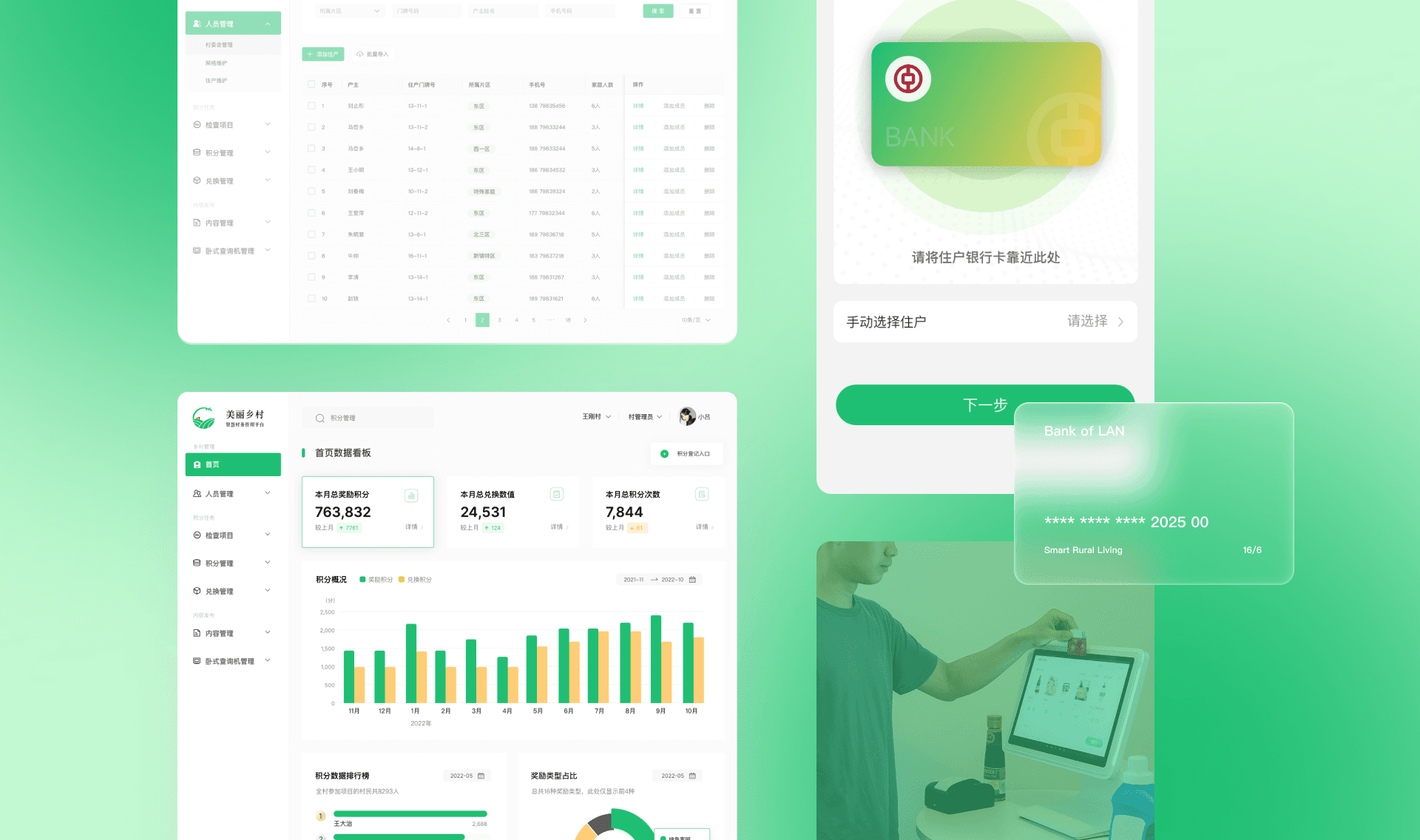
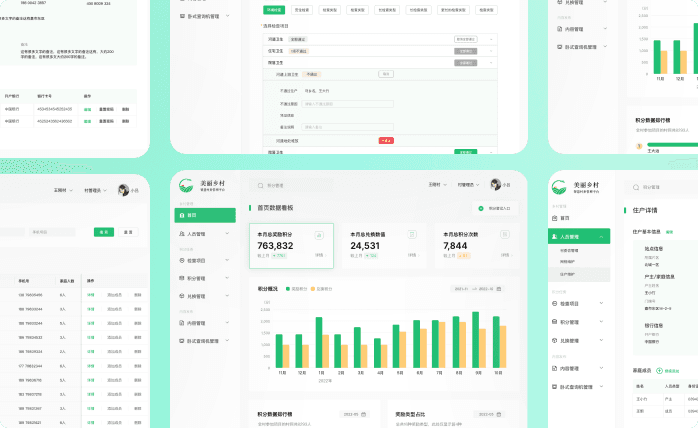
We developed a unified digital platform for managers, integrating rural governance management, data visualization, and key operational functions. This system reduces reliance on scattered software and paper documents, minimizes location constraints, enables clearer decision-making and simplifies daily tasks .
Homepage/Dashboard
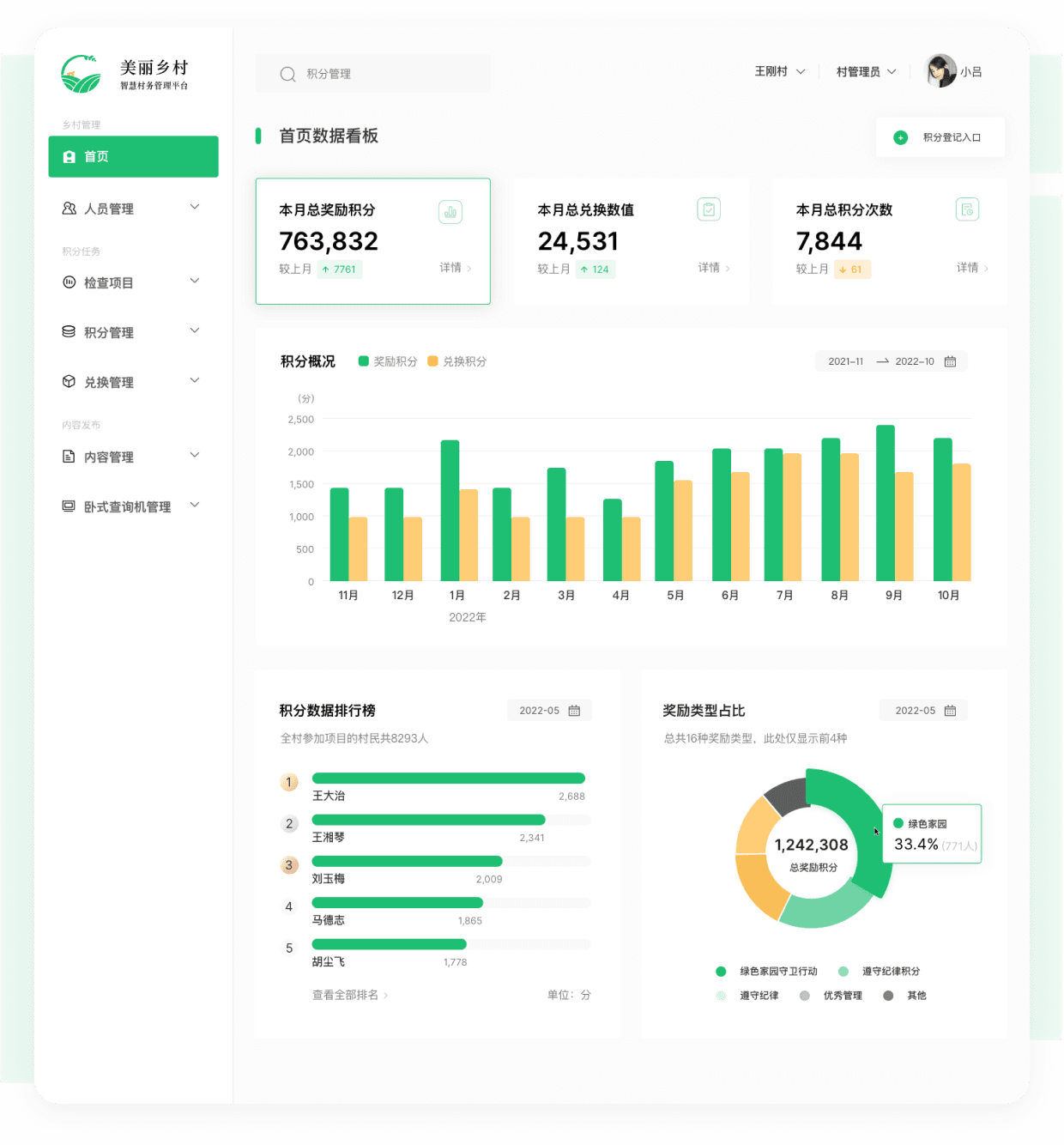
*Language note: All figures are in Chinese (zh-CN) UI; English annotations provided.
The admin control section allows administrators to switch regions, change roles, and access frequently used functions.
The data dashboard helps administrators get an overview of how the platform is running.
Changes in total points reflect the overall progress of the project.
The point types helps with task planning and analysis.
The points leaderboard shows how actively villagers are participating.
Management Module
Provides efficient, clear, and trackable digital support for offline use. Replaces traditional paper records and enables unified management and real-time updates of villager information.
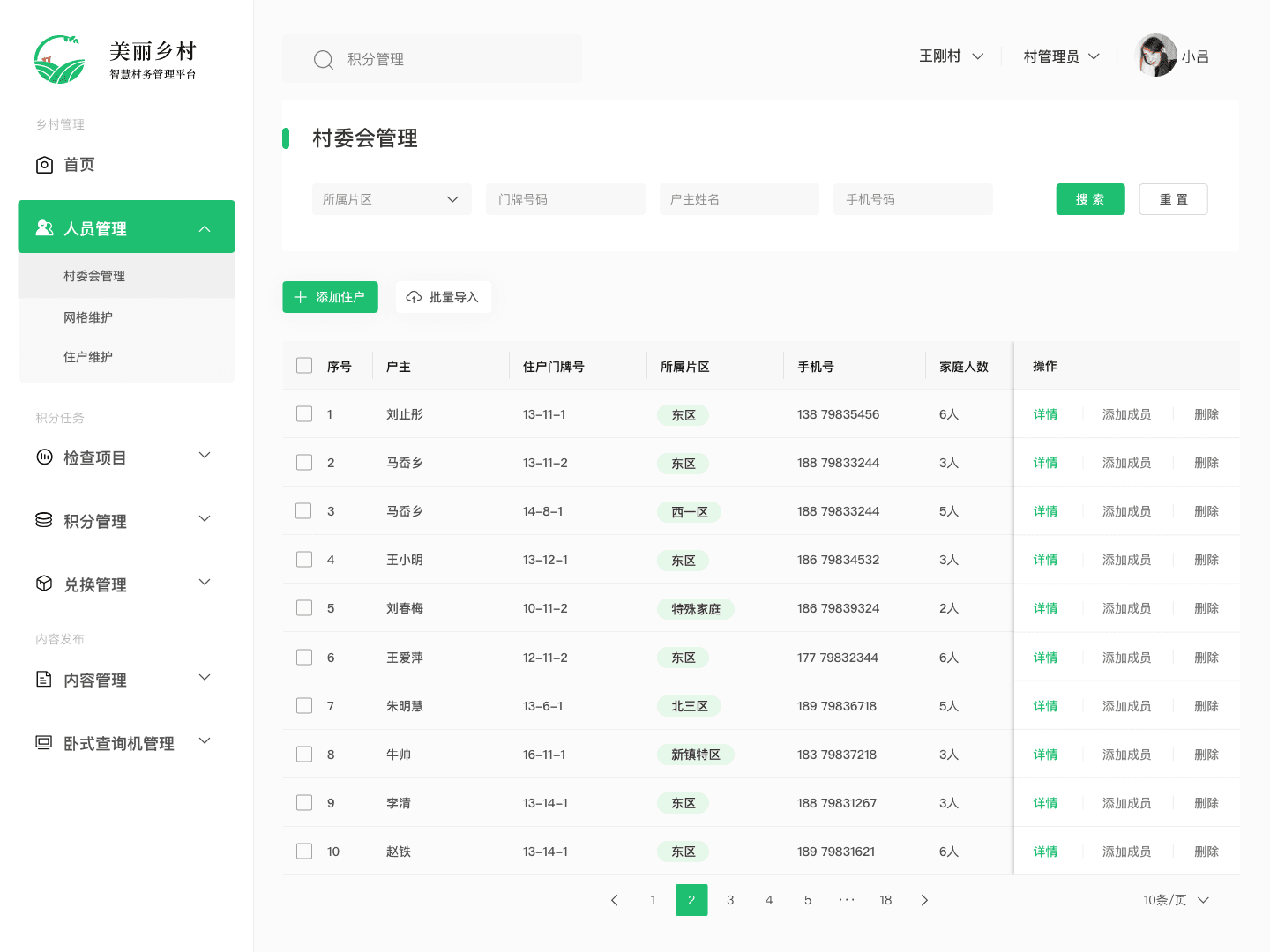
Integrated Management & Inspection Workflow
This module brings together villager information management and the full inspection workflow into a unified, digital operating system.
By replacing scattered paper records with structured profiles, standardized inspection forms, and real-time data synchronization, the platform reduces manual workload and ensures consistent, traceable governance data.
As a result, administrators gain clearer oversight, inspectors follow a streamlined process with fewer errors, and governance tasks become more transparent and scalable.
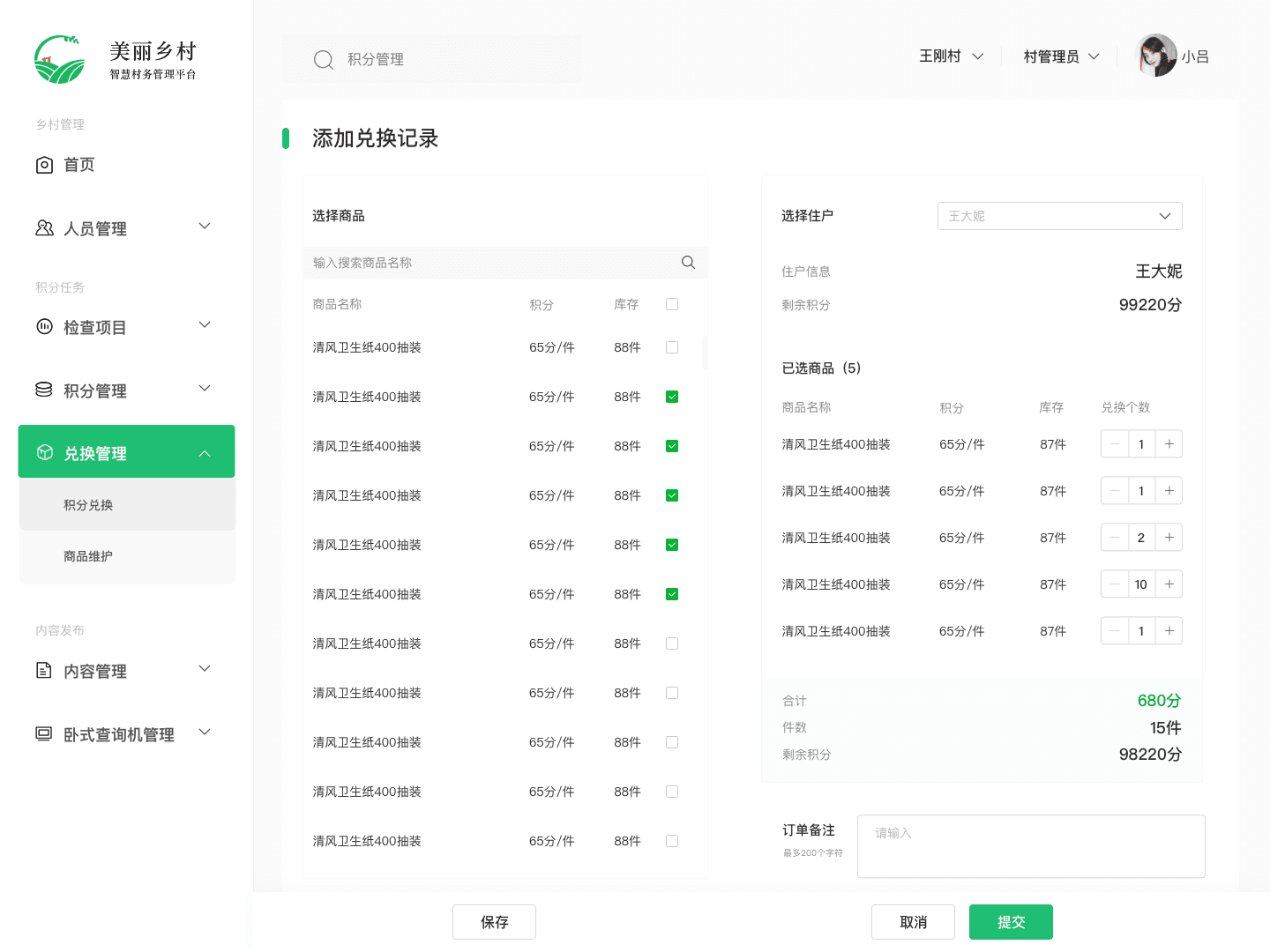
Points Management & Reward Redemption System
This module establishes a complete incentive loop by managing point rules, distribution records, and item redemption in one place.
By linking points to villagers’ financial identities and providing a transparent catalog for redemption, the system turns daily contributions into tangible rewards.
This not only motivates villagers to participate more actively in community tasks but also creates measurable engagement data that supports long-term governance improvement.
Design system
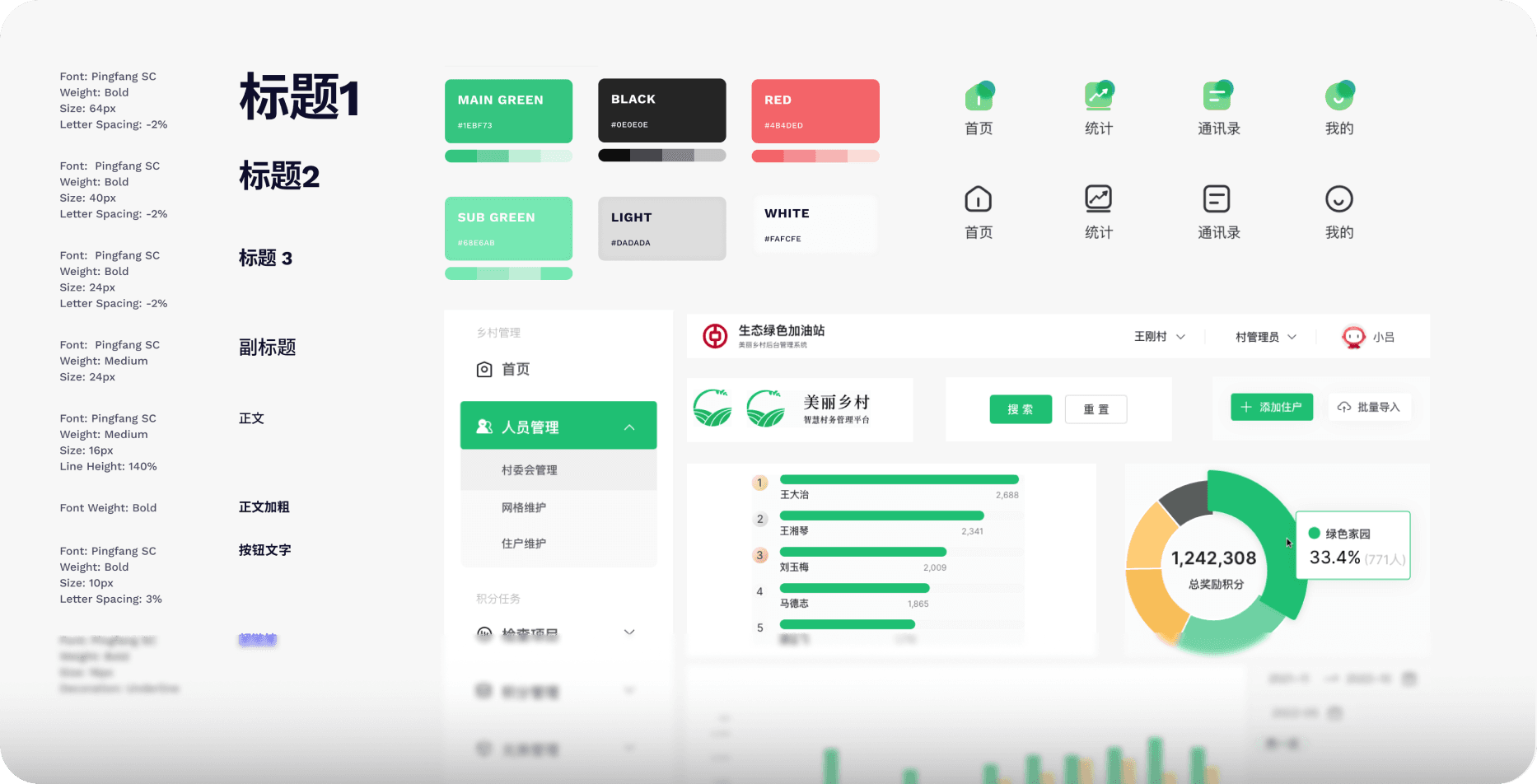
To support multi-terminal work, I set up a lightweight design system with shared components and guidelines.
Because the team was working in agile sprints and building different parts in parallel, we needed a simple way to keep visual and interaction patterns consistent.
Designers and developers used the system as a common reference, which reduced rework and kept collaboration smooth.
02
Mobile Inspection Tool
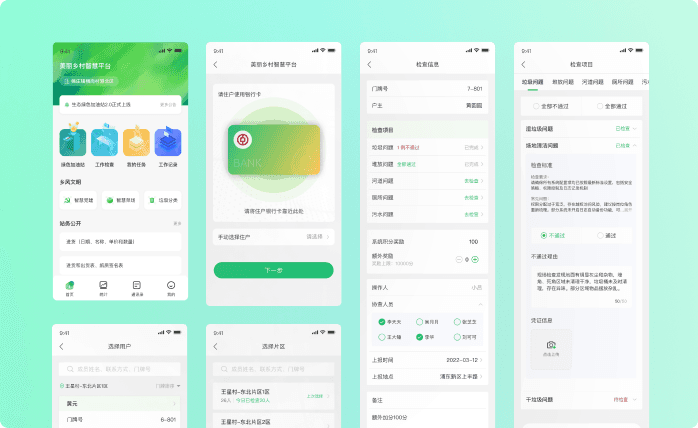
We provided inspectors with a mobile tool for real-time data entry in the field, replacing manual and paper recording methods. This improves task efficiency, replaces the previous pen-and-paper recording mode, and allows inspectors to focus more on the inspection itself.
Current Main Inspection Flow

Previously, inspectors carried paper forms during visits, manually searching for households, filled in scores and notes, then returned to the office to enter data again on the computer — a repetitive and time-consuming process.
Now, with just one device, they can score and record directly during inspections, with data automatically saved and synced — eliminating duplication and greatly improving efficiency.
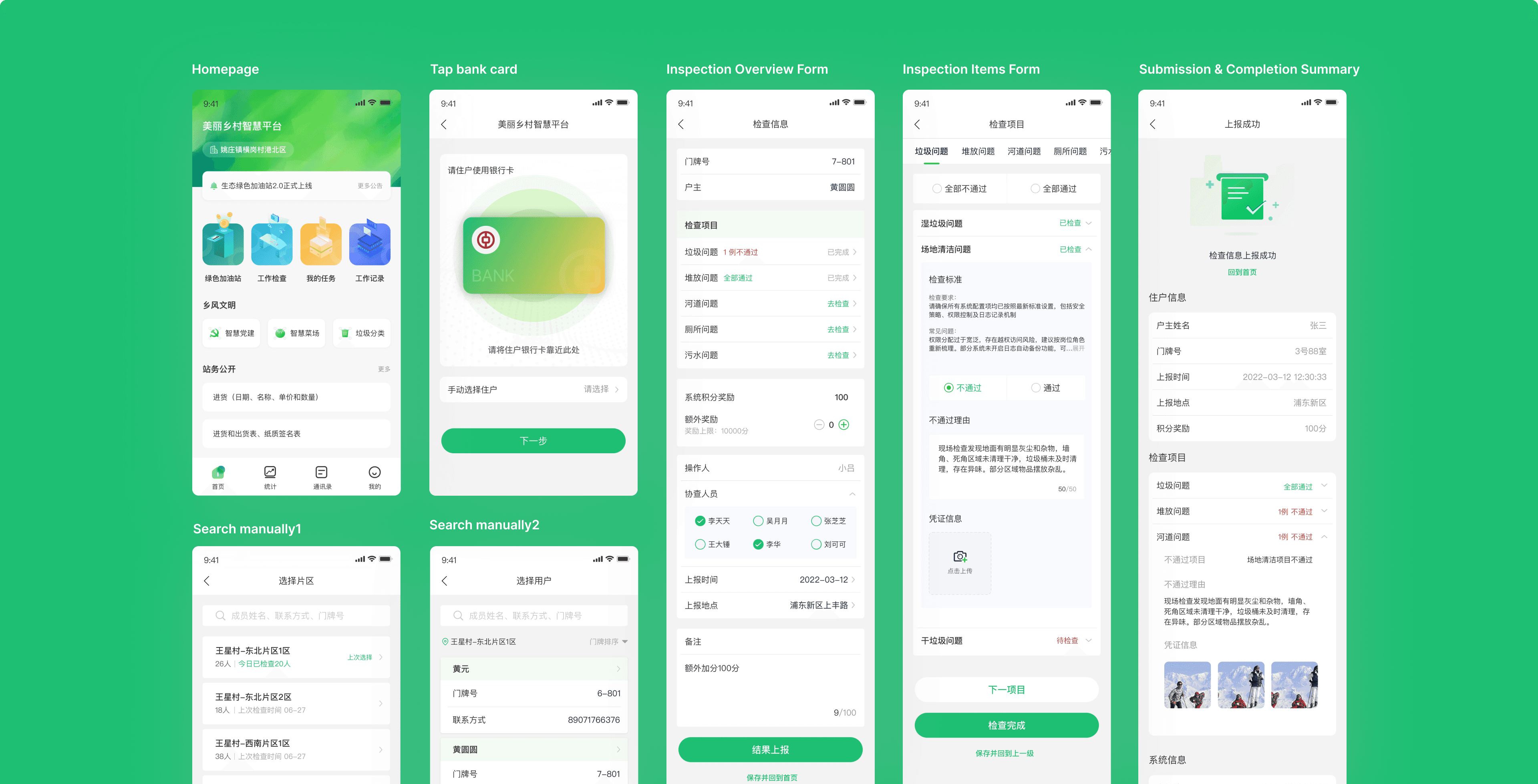
*In addition to the core inspection workflow, the system also supports task assignment, inspection logs, local governance news, and more.
03
User personal page
In-app web module embedded in BOC App
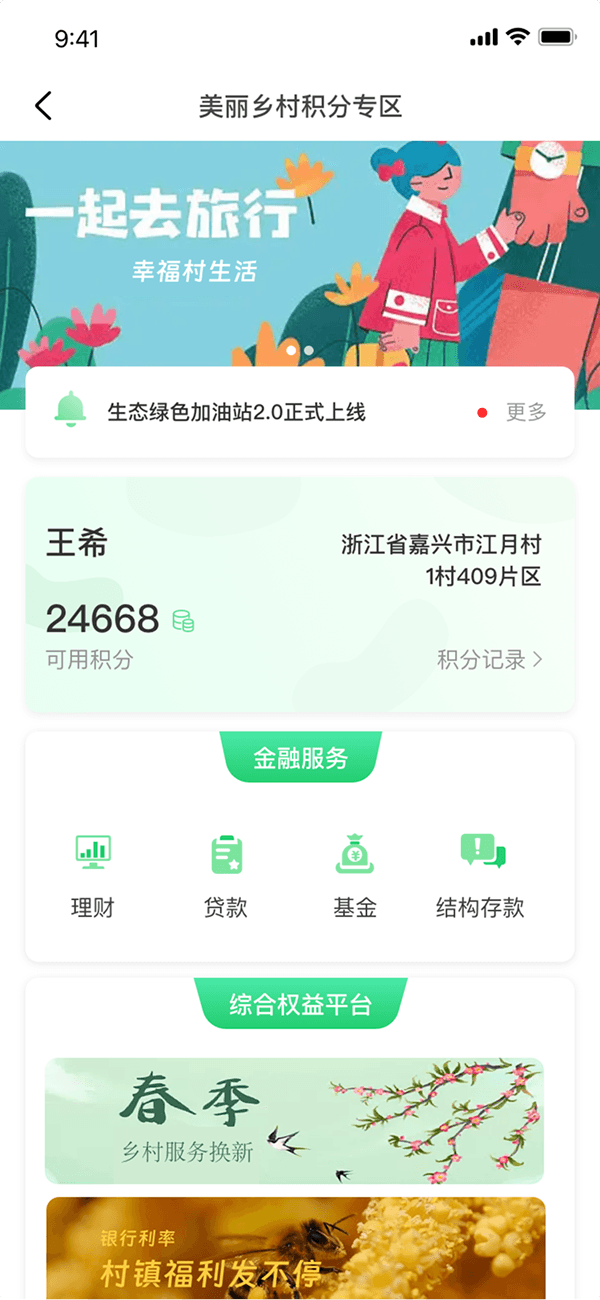
We built an easily accessible personal center for villagers, reinforcing their digital financial identity and add access to village information and financial services. This allows villagers to check their points and redemption history, receive government announcements and notifications, and participate more actively in village public affairs.
Villager Point Center
Each villager's points account is transparent and linked to their bank card. And promotes other bank services.

Announcement Detail
Activities, rules, and inspection updates are shared to ensure transparency and fairness to Villagers.
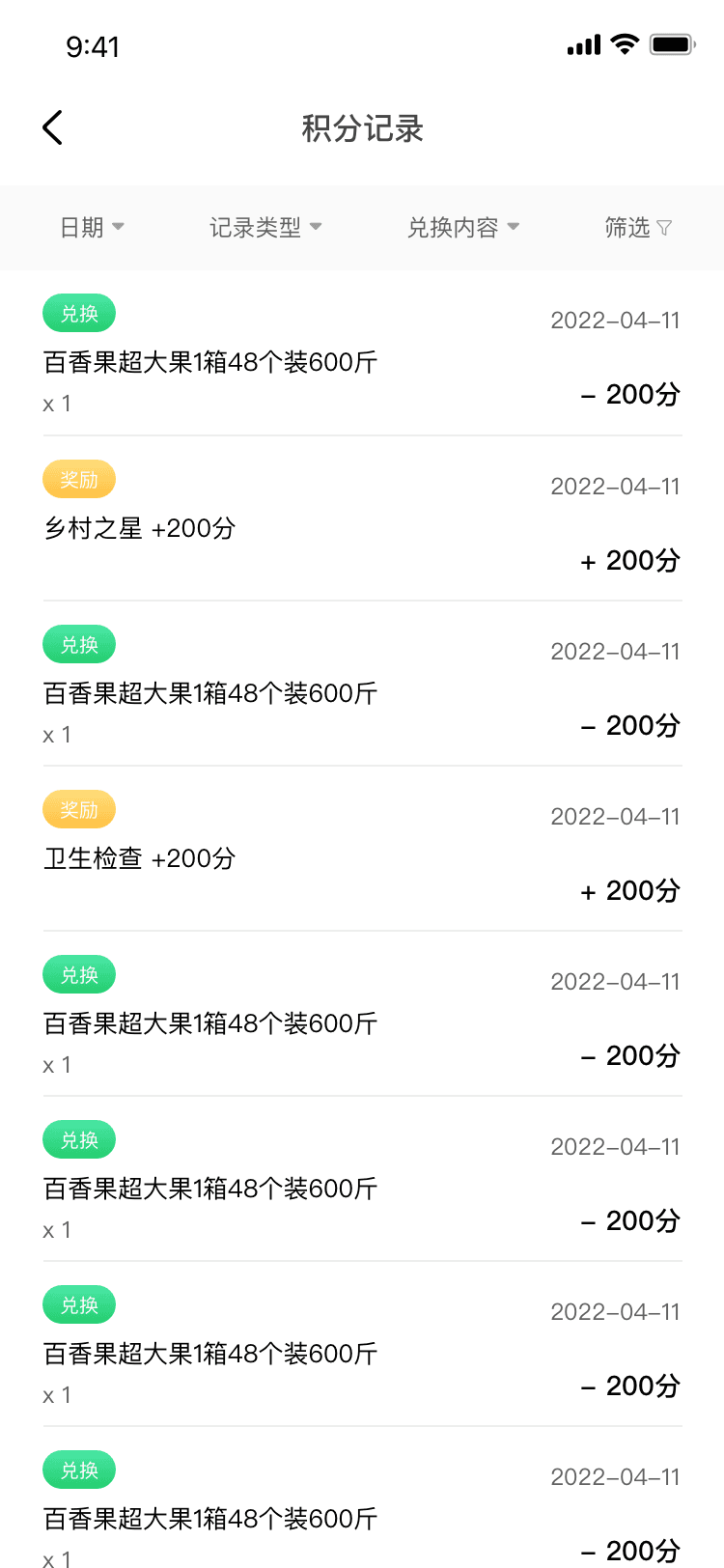
Point history
Detailed records are accessible, bringing convenience and a sense of trust to villagers.
04
Point redemption service
community redemption station
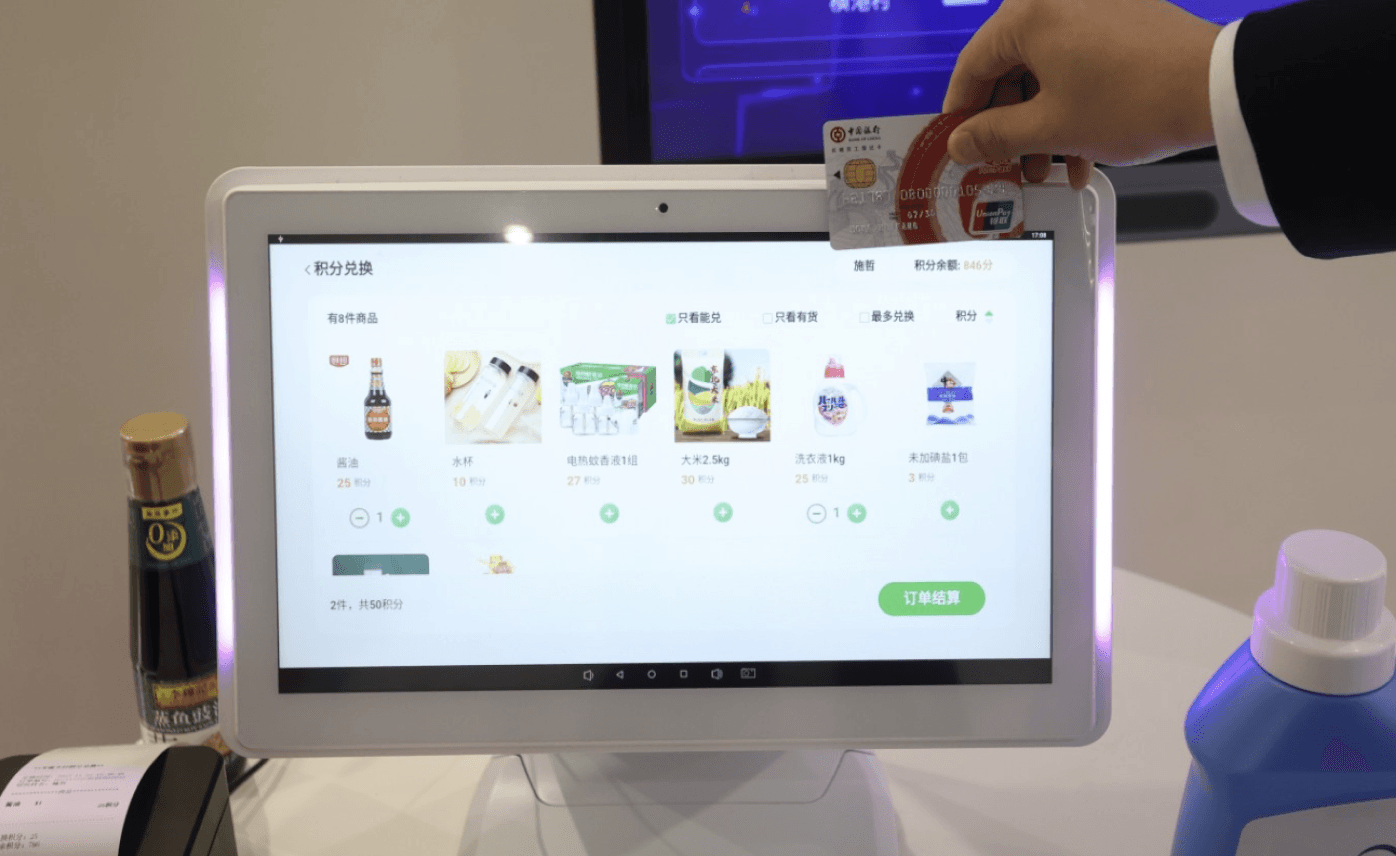
We built an offline service for villagers to redeem their points for real goods or benefits.
This allows the village governance project to form a complete loop—achieving both effective management and real benefits for the people.
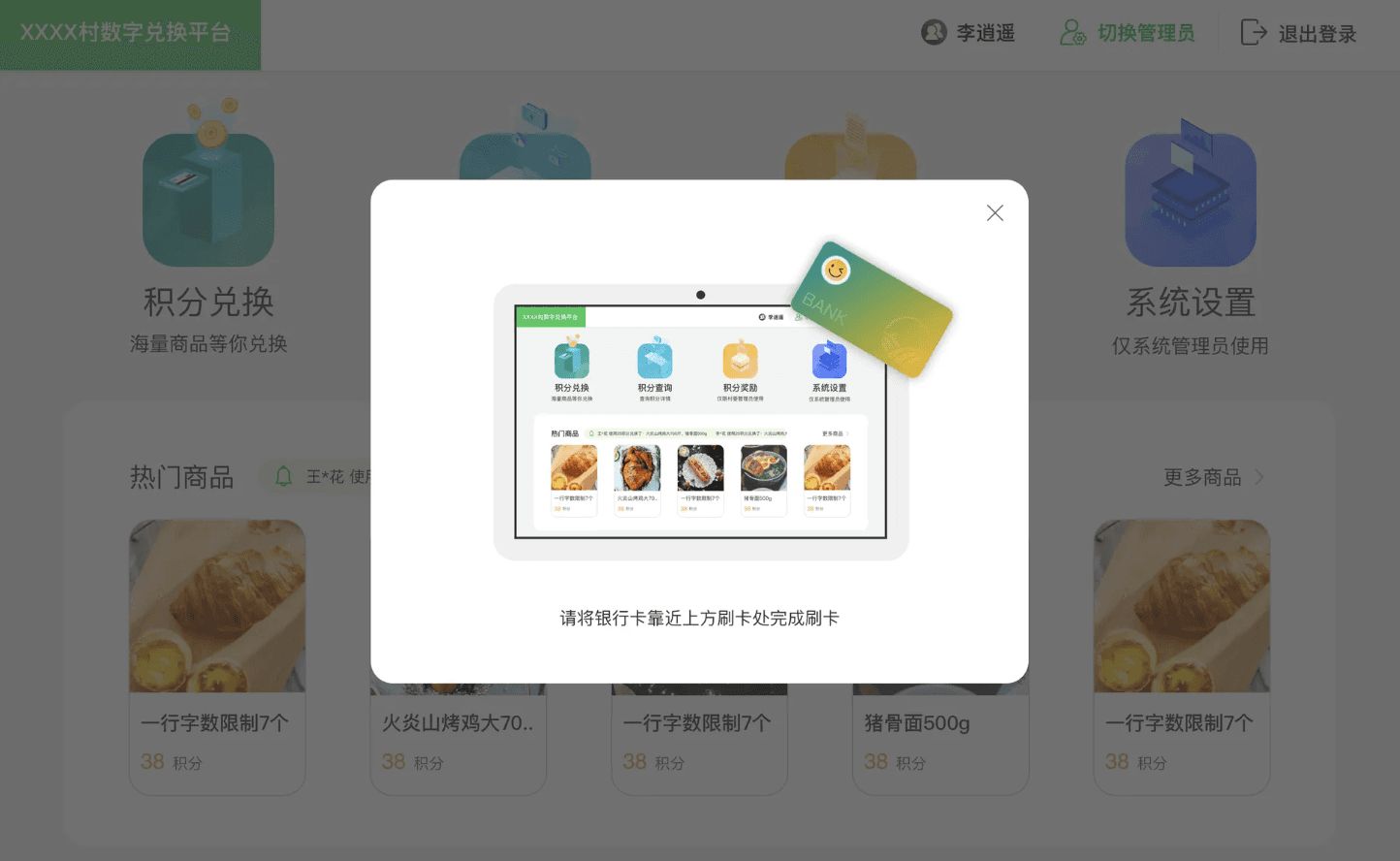
Swipe Card to Log In
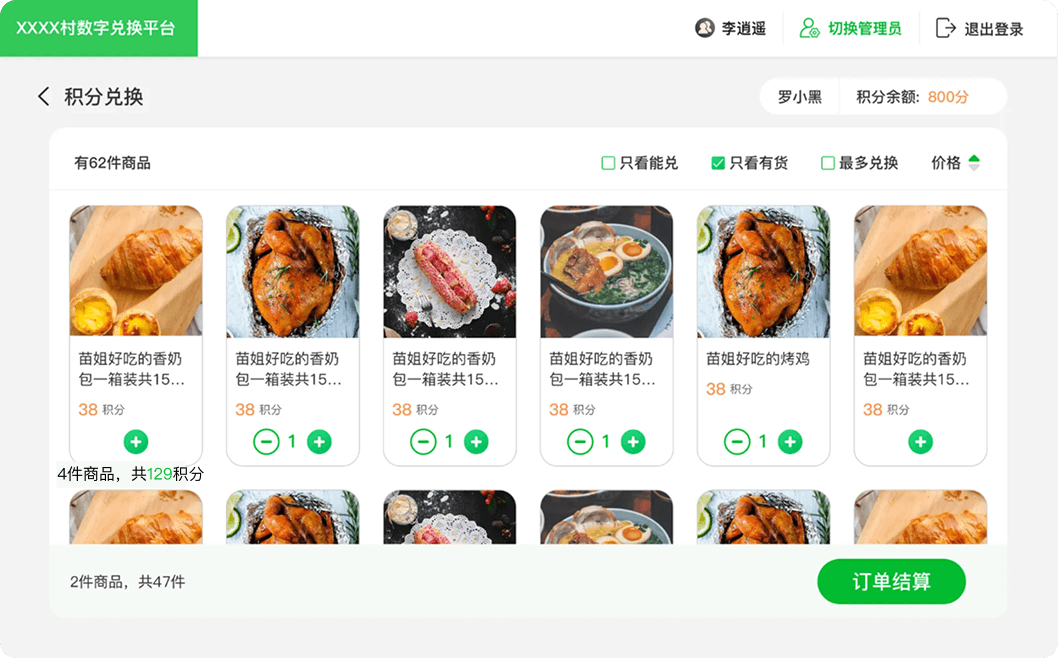
Reward Redemption – Product Catalog
41K+
This service has been deployed covering over 41K staff and villagers who are now using the system.
+12%
Monthly points volume grew steadily at ~12% MoM, with steady growth in redemption activity.
+50%
The average on-site inspection time per household was reduced from 1 hour to 40 minutes, improving efficiency by 50%.
70%
The villager participation rate in village rules and activities increased from 44% to 70%.
700+
Embedded financial service entries in the personal user center recorded a 12% average monthly CTR, with about 700 households completing BOC banking services over the year (6% conversion).
15
The project proved effective in the pilot phase and was subsequently scaled up, now covering 15 villages and towns nationwide(Jun 2025) .
Impactful Results
We built a service that completes the governance loop, increases villagers’ tangible benefits, and opens new financial service touchpoints for BOC.
Governance Digital Transformation
From paper to digital: Paper-based, fragmented workflows were unified into a single digital system across management, inspections, villagers, and redemption stations.
Closed-loop system: Rules → Inspections → Scoring → Public display → Redemption → Feedback → Data insights.
Banking & Business Value
New customer touchpoints: The points center module embedded in the BOC app expanded the bank’s digital presence in rural areas.
Data Asset Growth: By collecting transaction and participation data, BOC can better understand users, provide more suitable financial services, recommend relevant products.
Villager Engagement & Incentive
Financial identity integration: Linking points to each villager’s bank card makes participation visible and redeemable, strengthening their financial identity.
Participation Growth: Points incentives increased engagement in rules and tasks, while transparency improved involvement in community activities and local affairs.

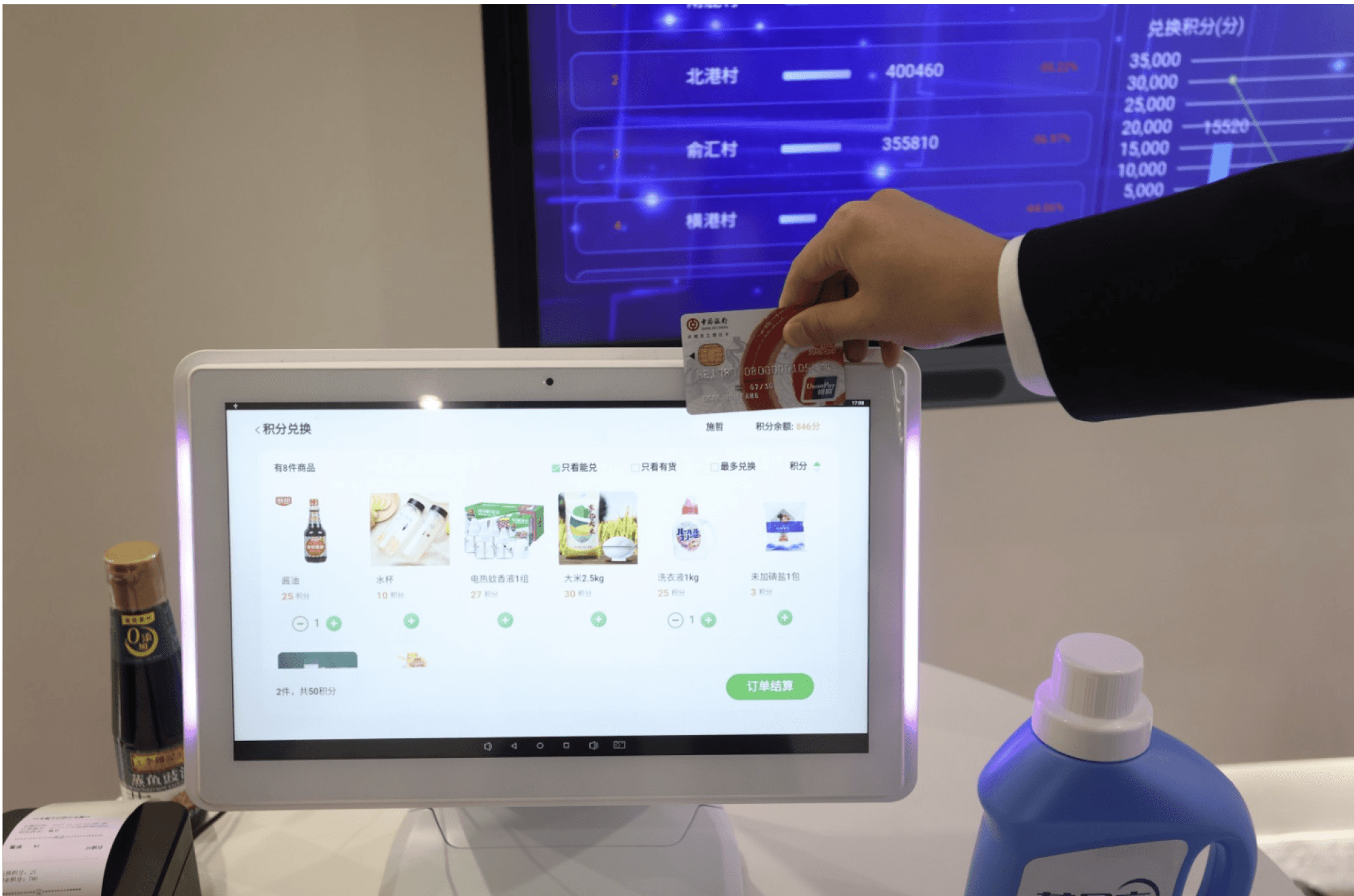

On-Site Product Testing
*Data comparison period: Nov 2022–Nov 2023 (12 months); scope: 6 pilot villages.
The latest data (as of June 2025) has not been fully released. The project is still in operation and has been expanded to 15 villages and towns nationwide.