BNU & Tangshuo
Online Medical Consultation —
End-to-End Service Design & Experience Strategy Case
Found problems in the development of online medical care and proposed optimization solutions
The Context
This project was part of a university–industry collaboration between Beijing Normal University and Tongshuo Consulting. Our team was tasked with exploring the current state and challenges of China’s online healthcare services and proposing feasible improvements. As the team lead, I guided the group to focus on the core question of how to enhance the usability, effectiveness, and trustworthiness of online medical consultations.
We carried out a full end-to-end design process—from user research, service journey analysis, and service blueprinting to multi-touchpoint experience solutions. I participated in the entire project and independently completed all UX/UI design work. The project received strong recognition from the industry partner, won first place across the entire course cohort, and was awarded the Second Prize of the BNU Innovation Scholarship.
My Role
Team Leader
The team
6 members
Duration
4 months
Research
Current situation of traditional medicine
Patient
Average waiting time: 90–120 minutes.
Over half consider medical visits too expensive.
46% of quality resources are concentrated in the east, making access difficult for patients in central and western regions.
Medical Institution
8% of tertiary hospitals handle nearly 40% of outpatient visits.
Over 50% of consultations are routine follow-ups and chronic cases.
Low digitalization: 60% of hospitals remain at the basic stage of electronic records.

China now has over 1,700 Internet hospitals, but more than 90% operate in a “zombie state”—built but barely used. Most platforms only support registration, payment, and report checking, while core services like consultation and follow-up remain rarely used. Only about 10% of Internet hospitals are fully functional.
The emergence of online medicine brings about opportunities and challenges

Persona
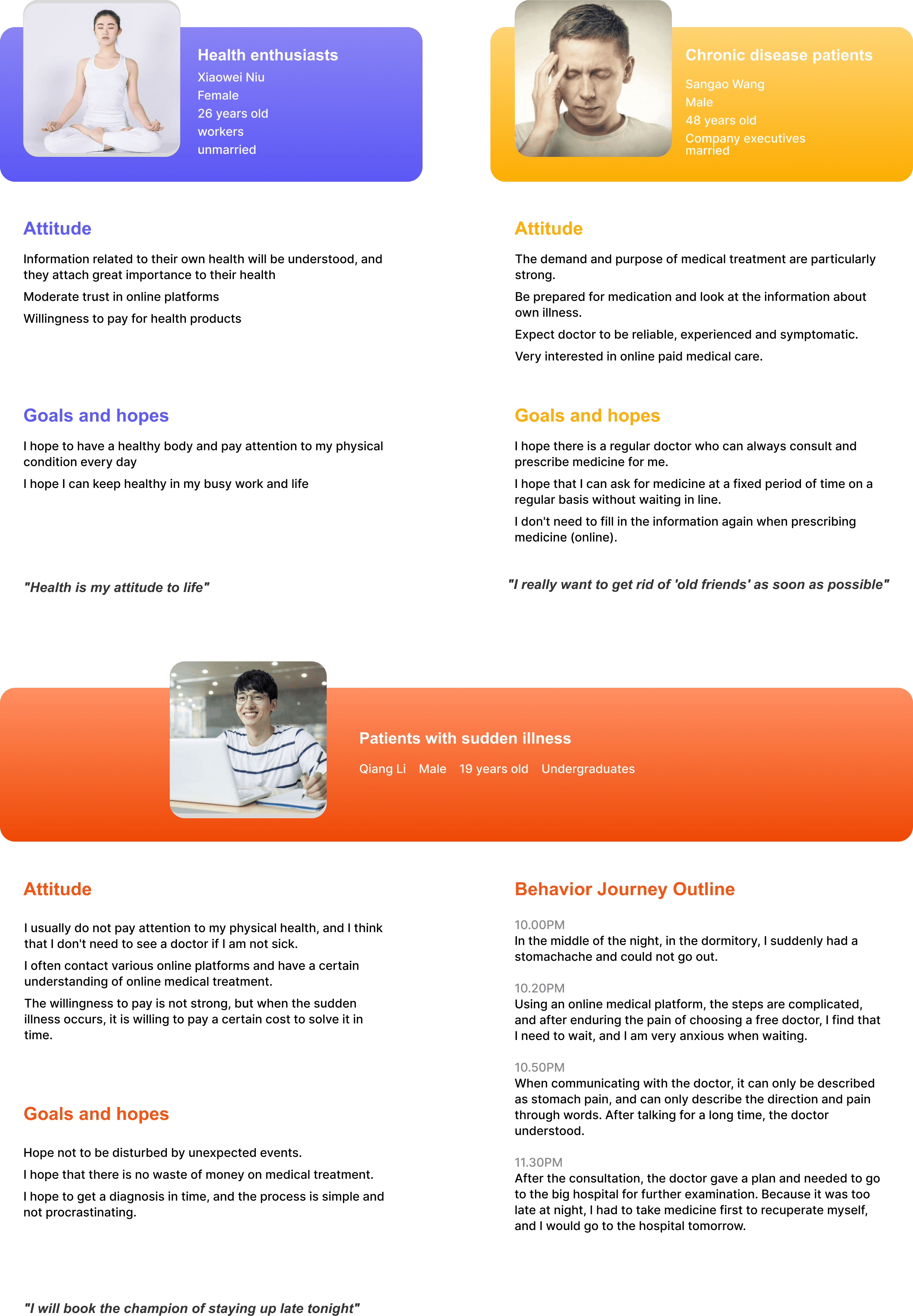
In the process of research, it is found that the group that uses online medical methods can be divided into these three types of typical users. Among them, patients with sudden diseases account for a large proportion, and they are more urgent to use the consultation link in online medical treatment in terms of behavioral needs.
User dimensions
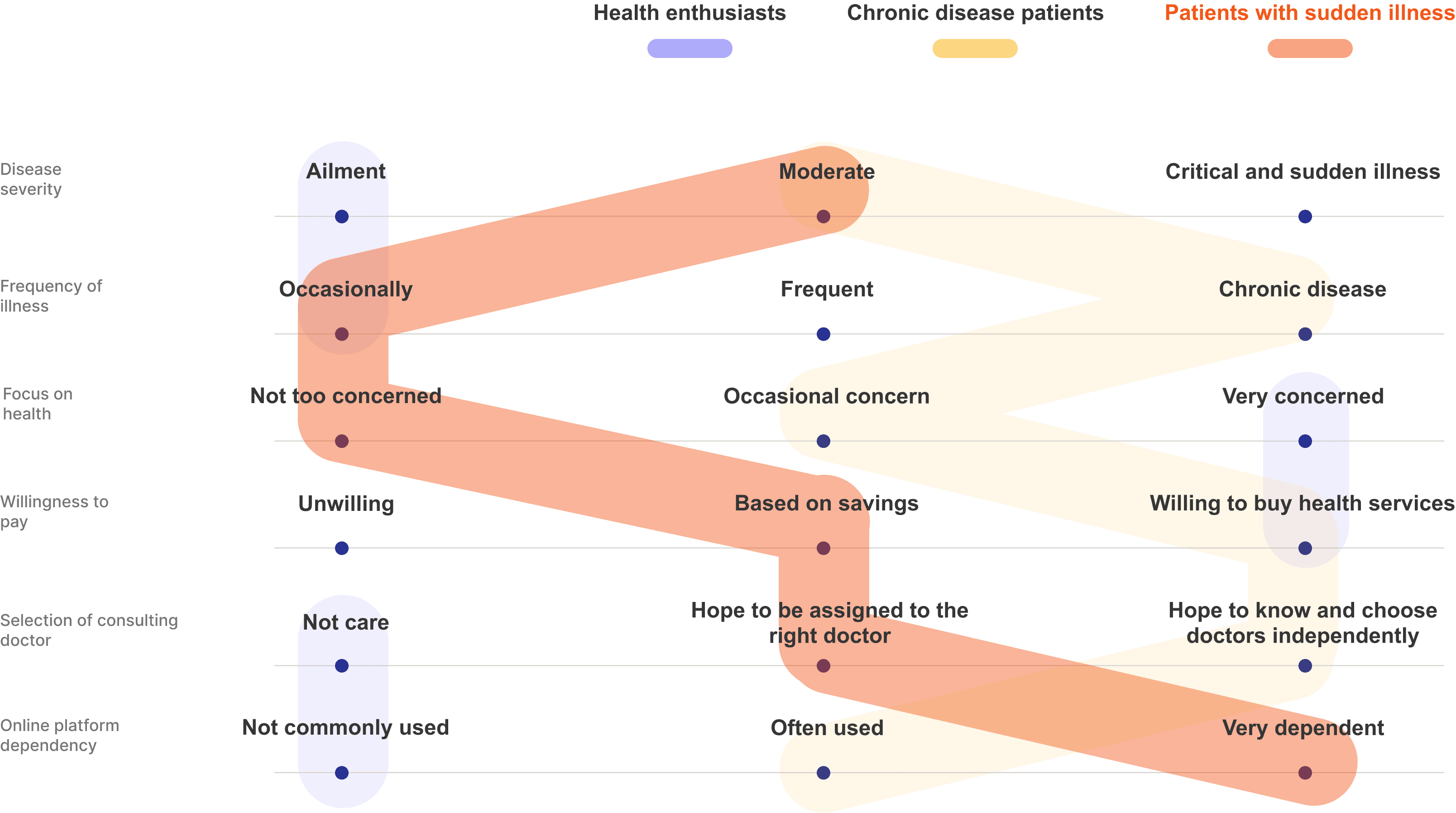
In the industry report on the analysis of online medical user groups in the research process, the following user latitudes can be summarized, among which the latitude trend of sudden patients is closer to the target group we want to explore - the group of online consultation in the case of emergency, which can expose the problems and results of the entire online process.
User interview
The interview outline is divided into seven dimensions, with a total of more than 40 exploratory questions. Each interview lasts about 45 minutes.
A total of 8 subjects with online consultation experience were interviewed in depth. By sorting out the interview records, the qualitative analysis method was used to extract user pain points.

User Journey Map
This journey map visualizes how users navigate an online consultation when facing sudden symptoms. It highlights emotional fluctuations and major pain points across the process, revealing opportunities to improve clarity, communication efficiency, and trust throughout the experience.

User Needs and Solutions
By structuring insights from “basic needs” to “experience expectations,” we clarified the functional and emotional gaps users face during urgent online consultations. Each solution is mapped to specific touchpoints in the user journey, ensuring that our design interventions directly respond to real behaviors and pain points. This alignment guided the formation of our multi-touchpoint service strategy.

Service Blueprint

Prototyping
Before medical treatment
The traditional text-based triage process is replaced with a mannequin interface that helps users visually locate symptoms and reduces cognitive load. At the same time, users can review doctor profiles and make their own selections, which strengthens transparency and trust during consultations.
Providing relevant case examples during the waiting period helps users understand similar situations and alleviates anxiety while they wait for the doctor’s response.

Promote communication efficiency
Two symptom-entry modes—structured options and free typing—are offered to suit different user habits and scenarios.
This enables users to provide more complete and professional symptom information, allowing doctors to better interpret conditions, identify causes, and communicate more efficiently.

Touch Point Innovation
Shared medical cabins set up in the community provide basic examinations such as blood tests. These objective results support online consultations and help doctors deliver more accurate diagnoses and treatment plans.

Final Thoughts
Through this project, we re-examined online medical consultation as a multi-touchpoint service system rather than a single digital interface. By integrating user research, journey analysis, service blueprinting and UX/UI execution, we revealed the structural gaps that prevent online consultations from becoming truly effective and trustworthy.
The final solution demonstrates how clearer symptom expression, more transparent doctor–patient communication, and auxiliary diagnostic support can work together to deliver a more reliable online medical experience. The project not only received recognition from the industry partner, but also strengthened my understanding of how service design and interaction design can jointly solve systemic healthcare problems.