
In Shanghai, China's most fashionable city, a phenomenon was discovered during 2022.
“Girls always dress more sophisticated than boys.”

Observe object selection
In the dating scene, both parties will present a better state of dressing, which can reflect their inner definition of better dress.
Score Rule: The complexity is to analyze the men and women in the picture, add and count the number of clothes, the number of bags, and the number of boots and socks, the scoring range is from 1 to 5. The degree of particularity is divided into 1-5 score grades, which represent from common to special, and are subjectively scored by the investigator. The harmony of collocation is divided into 1-5 score grades, which represent from casual to elaborate matching, and are subjectively scored by the researcher.
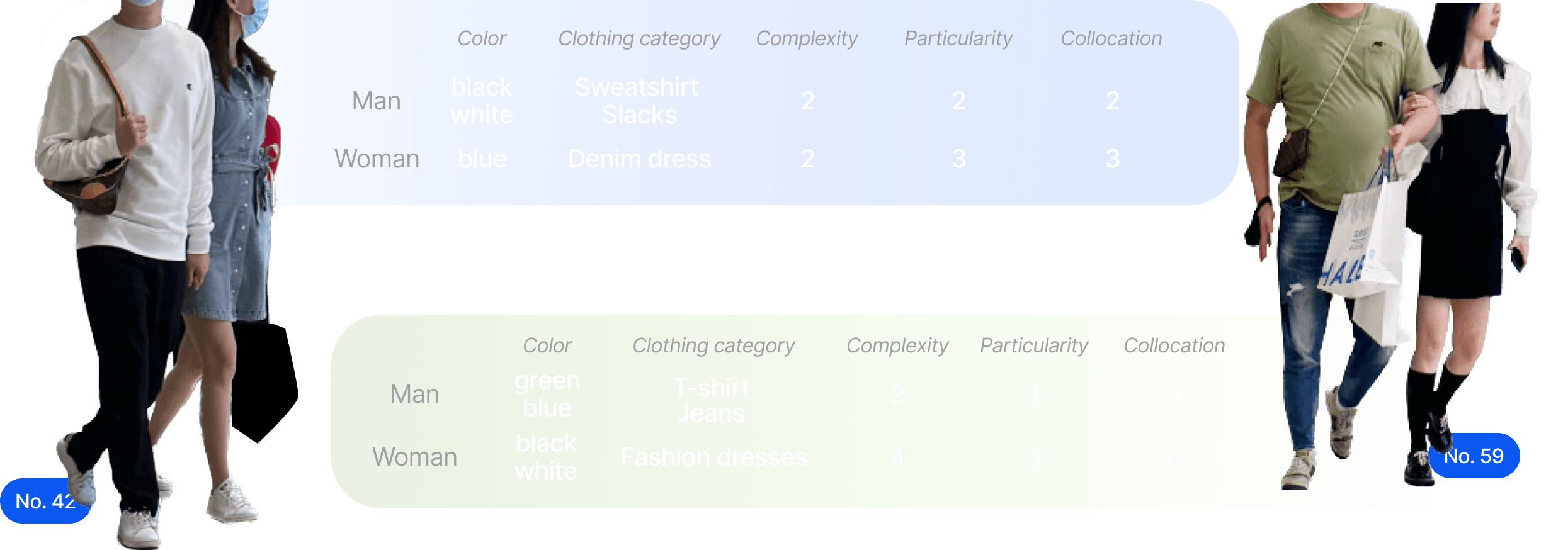

80% of women wore 3 or more pieces of clothing and accessories. Nearly half of men could go out on a date with just 2 pieces, such as tops and pants. Women's outfits were more sophisticated.

Nearly 80% of men kept their specialness at 2, with the remainder at 3. Nearly half of the women would choose a more special outfit to wear to an appointment. No one met 5.
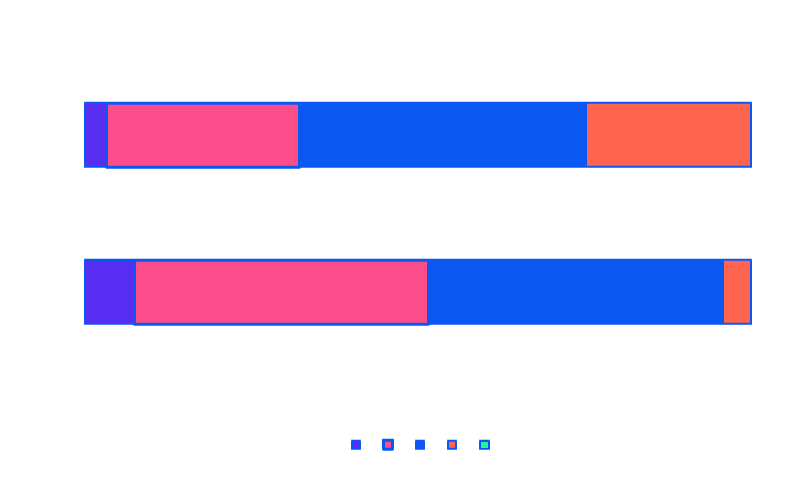
About half of the men were able to match the harmony, while nearly 70% of the women matched harmony, and the harmony was a little more in 4 for women than men. No one met 5.
In the 10 most popular shopping malls in Shanghai, 93 pairs of opposite-sex couples were randomly selected to record their outfits during the same period, and their outfits were quantitatively evaluated.
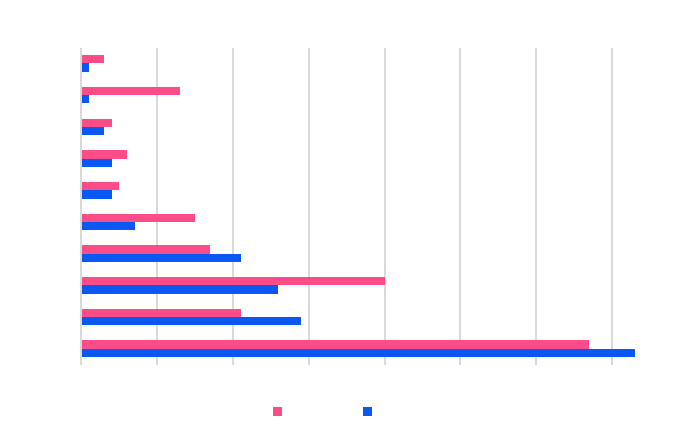
All of the clothing categories were collected and categorized into 28 categories, and the most popular men's clothing was Casual pants and Hoodies.
The girls' outfits are more diverse, with 10 categories being worn by girls only, mostly skirts.
It can be seen that boys have unique routines and consistent uniformity in dressing, and classic sweatshirts with casual pants are already common.
After statistics, it can also be seen that in addition to the common black, white, blue and gray colors, girls will consider other colors when dressing; Girls also use multiple colors more frequently than boys in a match.


By observing the men's and women's clothing brands in the mall, we can see the most traditional clothing design, and we can also see the current trend of clothing design and efforts made to reduce the imbalance in gender differences.
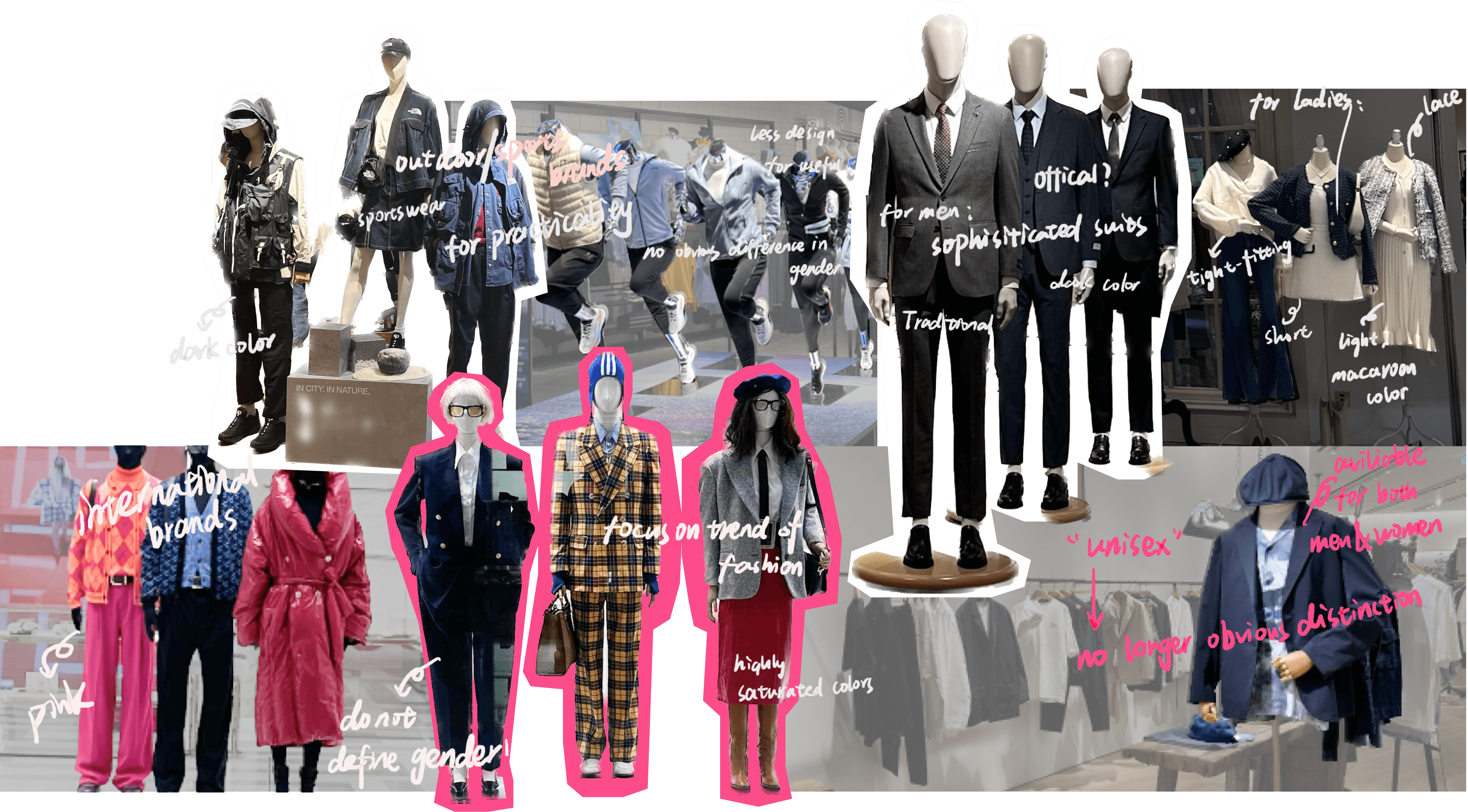
Clothing design originally has tool properties, in order to cover the body and avoid the cold.
Gradually, in order to cater to social forms and consumer psychology, elements in this context were added.

They found that women are more likely to buy clothes, prefer to spend more time on dressing, and are more eager to gain the attention and recognition of others from the gorgeousness and superiority of appearance.
Consumerism traps women in a beauty cycle that restricts them.
When women are portrayed as "beautiful genders", their bodies and appearance are controlled by consumer society.
On the one hand, the consumer society liberates people from sexual repression and fertility distress; On the other hand, it subordinates the human body to the demands of coercive beauty, and behind this appeal is the production logic of consumer society.

The objectification theory proposes that women have experienced information such as being stared at by others in the process of growing up, being emphasized in interpersonal communication, and highlighting the sexual attraction of women in media information, which directly or indirectly lead to some women accepting the perspective of a third party.

Although the awareness of gender equality is being popularized, the toys, textbooks, books, movies and various TV dramas that children are exposed to today contain traditional attitudes towards gender, which constantly convey the roles, goals and ideals that boys and girls should have.
For example,
men tend to play more active and risky roles.
Women are described as passive, expected and family-oriented.
Men are independent, capable, strong and dominant.
Women are beautiful, sexy, submissive and dependent.
In the end, clothing is not merely a surface we attach to the body, but a language that silently shapes how we are seen—and how we learn to see ourselves.
Through this project, I hoped to trace the invisible forces that script our everyday choices, revealing how gendered expectations are woven into the smallest details of dress.
If design can do anything, perhaps it is to create a moment of pause:
a space where norms loosen, identities soften, and individuals can choose presence over performance.
To dress without being defined, to be looked at without being measured—this is not only a question of aesthetics, but of freedom.
This work is a small attempt toward imagining that freedom.
